
Among the three sections of the CAT, DILR (Data Interpretation & Logical Reasoning) is often the real deal-breaker.
It is the second section, and your performance here heavily influences how you approach the third and final section, i.e. Quantitative Aptitude section.
A good performance in the DILR section builds confidence and momentum. A bad one? It can trigger panic and lead to a complete collapse in the remaining section.
Ironically, the sectional cut-off for DILR is usually not very high.
Since most of the students are unable to solve more than two sets in this section, even a small performance improvement can drastically boost your overall CAT percentile.
So why does this section feel so intimidating, and more importantly, how do you fix it?
Challenges

One of the biggest mistakes in CAT preparation is overemphasising Quant and Verbal Ability, and overlooking the DILR section. This is because students find set selection the most challenging task.
It is challenging to instantly judge which sets are doable, which are time-efficient, which ones should be skipped altogether, and what is the best approach for solving the sets.
Imagine grinding for 15-20 minutes on just the first two sets, only to find yourself totally stuck. By the time you reach the third set, the ticking clock and a fear of failure take over.
You’re in full test-day-panic mode, and suddenly, even the easy sets feel like impossible puzzles, causing a complete loss of confidence.
Unlike Quant, there is no fixed formula in DILR. Every set is different, and logic doesn’t always click instantly.
The constant “what if” fear – “What if I can’t solve even one set? What if I am unable to clear the sectional cut-offs? What if my overall CAT score drops? Often prevents you from performing to your true capacity.
This fear blocks logical thinking, and the right approach fails to click at the right moment.
- Trying to attempt the sets without scanning them carefully
- Spending over 15 minutes on a single challenging set
- Overlooking solvable questions
- Trying to attempt all the sets
- Overlooking difficult sets during practice and mocks
How to Improve?
Begin your DILR preparation 8-10 months before CAT. Dedicate the first 4-5 months to building a solid foundation, and spend the remaining 4-5 months mastering the topics through practice.
Phase 1: Build a Solid foundation
1. The Correct Approach
Initially, your objective should be to learn the correct methodology for decoding information and structuring data.
To do this, practice at least 10 sets of each key topic under strict time constraints.
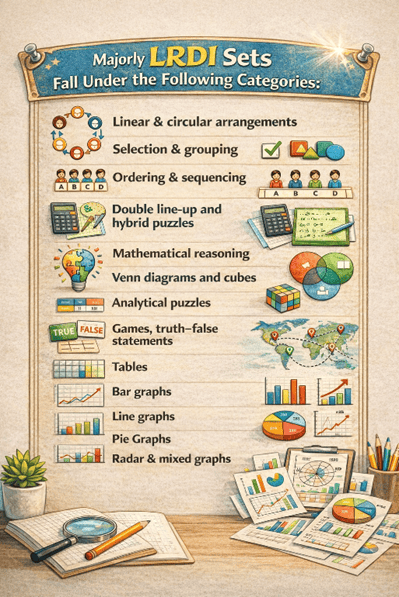
Majorly, DILR sets fall under the following categories:
- Linear & circular arrangements
- Selection & grouping
- Ordering & sequencing
- Double line-up and hybrid puzzles
- Mathematical reasoning
- Venn diagrams and cubes
- Analytical puzzles
- Routes & networks
- Games, truth–false statements
- Tables
- Bar graphs
- Line graphs
- Pie Graphs
- Radar & mixed graphs
Although CAT is heavily focused on Logical Reasoning, one cannot overlook the significance of Data Interpretation, where success hinges on quickly comprehending data and performing rapid calculations.
Train yourself to solve sets under time pressure: 8-10 minutes (Easy-Moderate), 12-15 minutes (Moderate), 15-20 minutes (Advanced). Carefully structure data in tabular form whenever possible.
Focus on primary information first and then use secondary information to fill in the gaps. Keep your approach simple and approximate your calculations.
2. Analyse Every Set (Non-Negotiable)
Real progress happens during the review phase. Once you finish a set, watch the video explanation to pinpoint your mistakes and analyse the logic used.
Try to build a mental map of the approach discussed and memorise the steps taken to solve the set.
Use what you learned here to approach the next set.
3. Parallel Practice with CAT Previous Year Questions (PYQs)
These sets are essential for DILR preparation, as each offers a unique logic and a distinct, challenging approach.
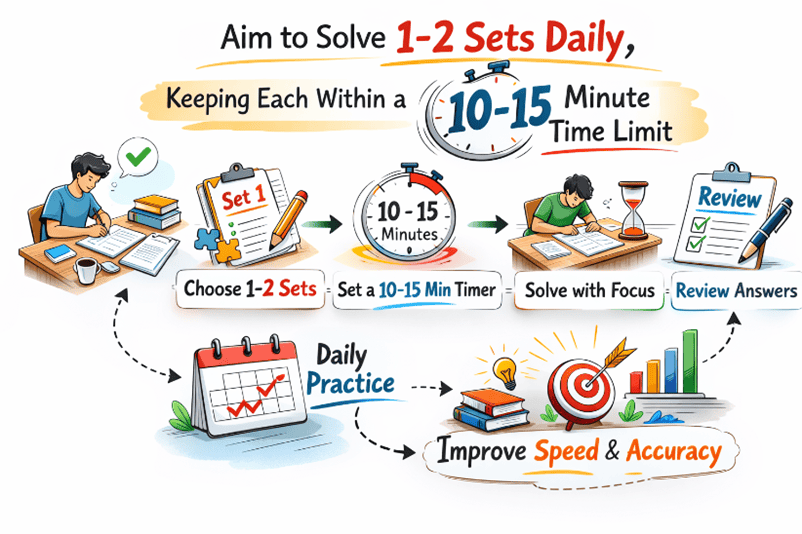
Aim to solve 1-2 sets daily, keeping each set within a 10-15 minute time limit.
Often, you don’t need to solve an entire set to answer one or two specific questions. Spot these early; they can help you eliminate options for other questions within the same set.
Keep in mind that perfect solutions don’t exist. Focus on the effort and the alternative techniques you build to overcome difficult challenges.
Finally, always watch the video solutions to address your weak points.
Phase 2: Practice and Build Speed
Now that you’ve covered the basics and solved past papers, put your skills to the test with rigorous sectional and mock tests.
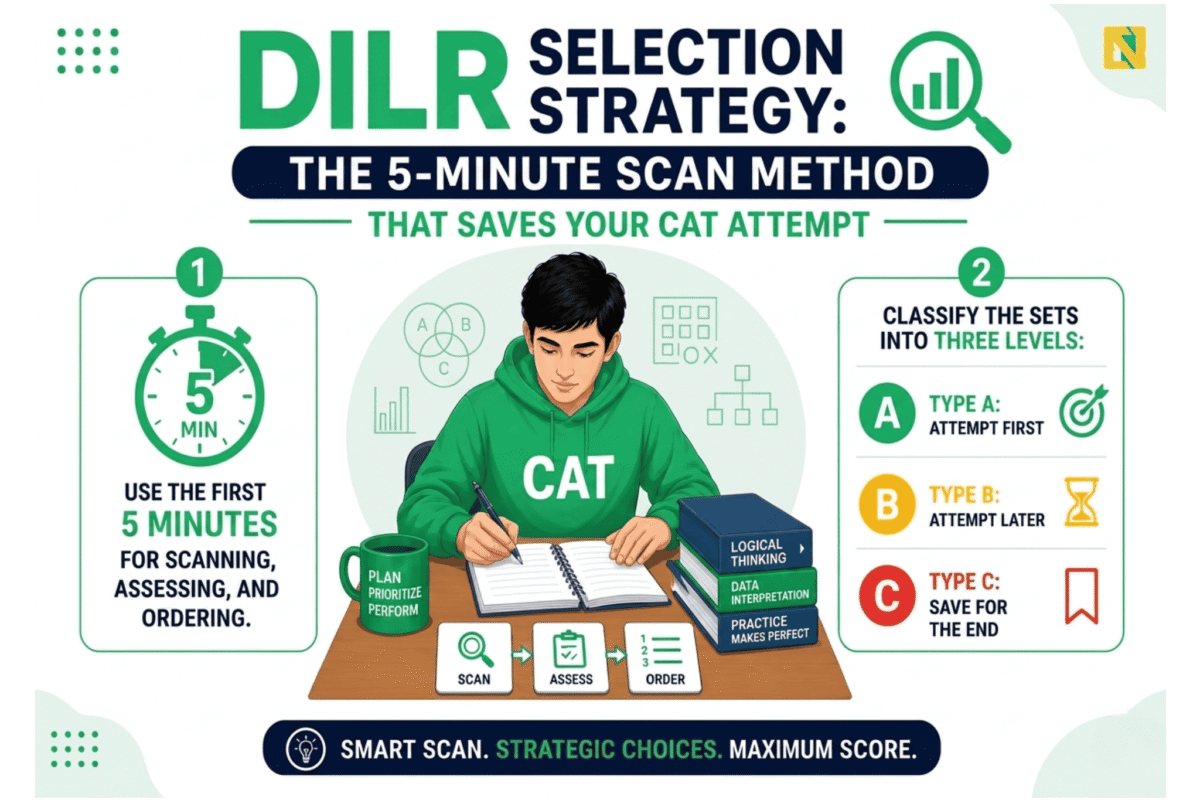
1. 5-Minute Scan Method and ABC Approach
The most common pitfall for students is rushing into calculations.
Use the first 5 minutes for scanning, assessing, and ordering:
- Look for the length and complexity of the sets (very wordy sets or sets involving too many variables are risky).
- Identify the sets with easy-to-understand data (tables, networks, and arrangements are easier to structure)
- Select sets that align with your mock test experience and that feel familiar from your CAT PYQs practice.
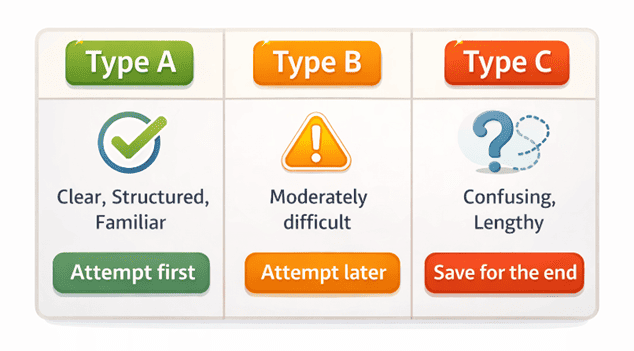
- Classify the sets into three levels:
Type A: Clear, Structured, Familiar (Attempt first)
Type B: Moderately difficult (Attempt later)
Type C: Confusing, Lengthy (Save for the end)
- Finally, decide on the order in which the sets must be attempted.
This simple process reduces panic, saves time, and ensures early momentum.
Successful test-takers don’t solve more sets; they pick better ones.
Apply the 5-minute scan method and ABC approach to boost your score in sectional tests, in mock tests, and ultimately in CAT.
2. Sectional Tests
To get high mock scores, take 30-40 sectional tests that gradually get harder, covering varied topics.
Try to answer over 60% of questions in each test with 80-90% accuracy.
Watch the video solutions after each test and draw a mental map of the steps taken and approaches discussed.
3. Full-Length Mock Tests and CAT PYQs
Take full-length mock tests. This is where everything comes together.
Simulate the exact conditions you will face in CAT.
If you get stuck on a set, move on according to your pre-planned order and return to it later if time allows.
Maintain a steady pace, and if you haven’t solved a set in the first 20 minutes, stay calm – it just means the easier ones are still to come.
Analyse your mock test results thoroughly, identify and address your mistakes, and prepare for the next test.
In this phase, reattempt CAT PYQs with a strict 10-minute time limit, even for advanced sets.
Final Thoughts
CAT DILR is not tough. It is just unpredictable; fear, poor preparation, and a chaotic approach make it seem harder.
Stop looking for shortcuts and start building a strong foundation.
Practice consistently, and you’ll turn this section into your top-scoring area in CAT.

Turn DILR into your Highest-Scoring Area
At ExamNest, we don’t just focus on teaching the concepts. We train you to win all sectional cut-offs that push your CAT percentile.
If you want:
- Structured DILR preparation
- Interactive doubt-solving sessions
- Rigorous sectional practice tests an5 Common DILR mistakes that hurt your overall percentile: Trying to attempt the sets without scanning them carefully
Spending over 15 minutes on a single challenging set
Overlooking solvable questions
Trying to attempt all the sets
Overlooking difficult sets during practice and mocksd mock tests - Personalised improvement strategy
Enrol at ExamNest today and prepare with strategy, not stress.
Frequently Asked Questions
Is DILR the toughest section in CAT?
Yes, DILR is considered the toughest section in CAT, largely due to its undefined syllabus and difficulty in selecting and solving sets under time pressure. A major hurdle is that simply reading and grasping the logic of a set without even solving it can consume 5-6 minutes, and even then, there is no guarantee of reaching the correct conclusion.
What is a good score in DILR?
Solving 12 to 15 questions with 90% accuracy and scoring 32+ marks can help achieve 99+%ile in the CAT DILR section.
How can I improve in DILR?
To score high in the DILR section, build a strong foundation by practicing 1-2 diverse sets of different toughness levels every day under a strict time limit. During analysis, focus on understanding the approach and creating a mental map of the steps, rather than just reviewing the answer. Regular, in-depth practice of previous year questions (PYQs) is crucial for developing set-selection skills and familiarizing yourself with common variations.
Is solving PYQs only enough for DILR preparation?
Solving PYQs will help you learn the variations and build the right approach in selecting and solving the sets in the exam. However, the sets asked in CAT are unique and require creative thinking; therefore, it is essential to practice quality sets in addition to PYQs to enhance your score in the DILR section.