
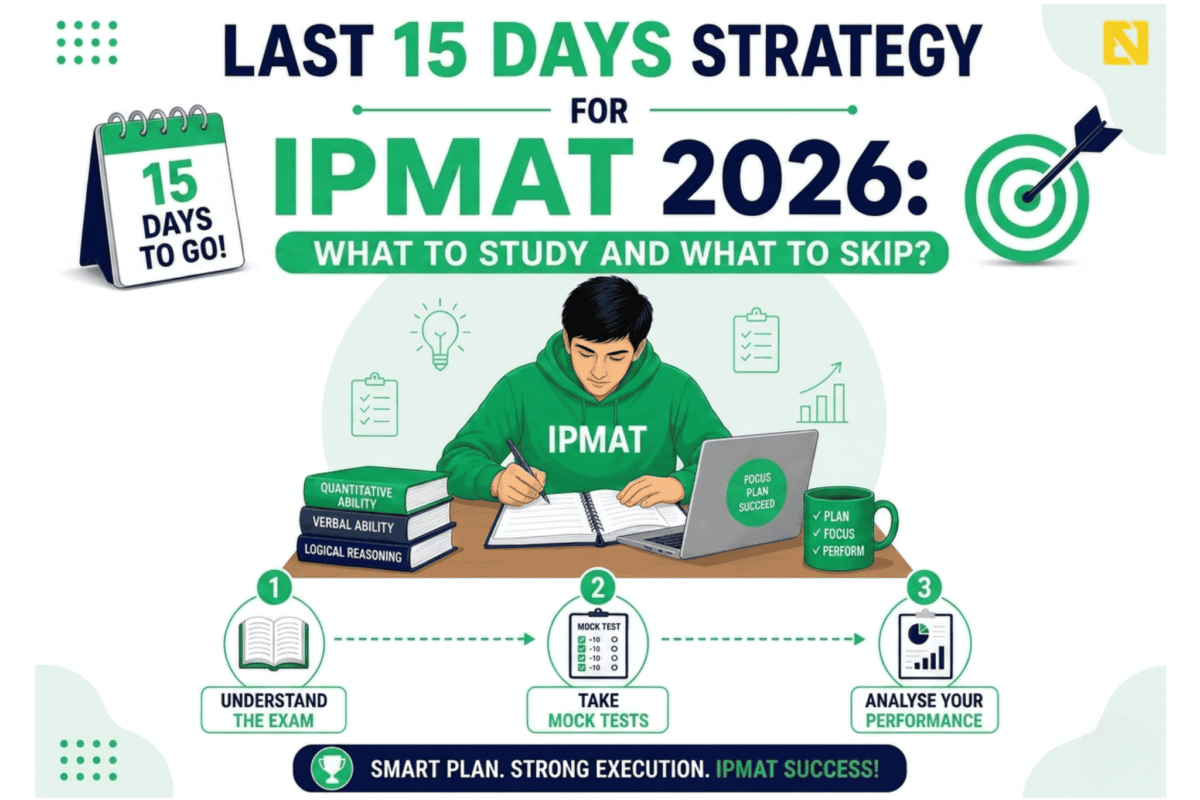
The last 15 days before IPMAT are the most crucial in your preparation. Here, a positive attitude and proper strategy matter more than the number of hours you study. The right approach can play a key role in your success, but a lack of direction or self-doubt can undo months of preparation.
Know your exam:
First of all, it is important to know the IPMAT structure and the topics that carry more weightage than the others. Focus on important topics you are already comfortable with, and try to build confidence in the remaining areas. Trying to master everything at this stage can be time-consuming and may not produce the desired results, so play smart, not hard.
Importance of Mocks:
Mock Tests are your best friends at this stage; they not only help you identify weak areas but also provide a guideline for the right approach. Take one full-length mock test daily, scheduled at the same time as the actual exam, under real exam conditions.
Merely taking tests is not sufficient; you need to analyze them thoroughly, identifying mistakes like not selecting easier questions, spending too much time on tougher ones, or making careless errors in typing the answer or marking. Work on your weakness before the next mock and plan a proper strategy.
Writing Mocks:

Normally, in the IPMAT Quantitative Aptitude (QA) section, you will find 40-50% easy questions (A-category), 20-30% moderate ones (B-category), and the rest tough questions (C-category).
While attempting the QA sections, apply the A, B, C approach: attempt A-category questions immediately, mark B-category questions for review to attempt later, and leave C-category questions to be attempted at the end if time permits.
Avoid solving Logical Reasoning and Data Interpretation (LRDI) questions asked in the QA section initially; attempt them later once you’re confident of clearing the cut-off.
For the Verbal Ability and Reading Comprehension (VARC) section, quickly scan the paper to identify easier questions. Solve questions on idioms, fill-in-the-blanks, sentence correction, and word usage first, as they are easy to crack and take less time, followed by para completion, parajumbles, and one or two RC passages.
For better performance in grammar and vocabulary questions, read the sentences in parts and try to identify the right clues. Questions on parajumbles are TITA type (you type the order) and also carry negative marking; they should be attempted only when you are confident. In the end, pick up the remaining tougher RC passages to conclude the section.
Remember, things do not always go the way you have planned them; prepare yourself for uncertainty and contingency.
Some sections may feel tough, and some mocks will go badly. Train yourself to think: “even if things go wrong, how do I recover?” This mindset will help you stay composed during the actual exam.
Post Mock Revision Strategy:
Instead of random studying, pick one important topic of QA and solve all previous IPMAT and, if possible, CAT questions from that topic, adhering to strict time constraints (3 minutes maximum per question).
After solving the question, review the solution to create a mental map of the concepts and steps involved, while revising your notes on that topic.
For LRDI, solve two analytical puzzles and one to two DI sets daily. Do not overburden yourself with tough sets or puzzles; PYQs can help you identify the right difficulty level.
The focus must be on identifying the key information given in the puzzle and avoiding secondary information initially. Also, structuring the information provided can help you solve the sets quickly and with less confusion.
For VARC, solve PYQs in a test format (40 minutes) and score 120+ marks consistently. Learning 20-30 new idioms daily, along with solving 5 questions each on fill-in-the-blanks, sentence correction, word usage, para completion, and para-jumbles, plus 2-3 high-quality RC passages, will establish a solid rhythm and help you score high.
Last 24 Hours Before IPMAT:
Do not take any mock tests. Revise light concepts if you want, take proper rest, and spend time on activities that relax you. Most importantly, do not stress; your confidence will play a huge role now.

During the Exam:
Read the instructions carefully to avoid any last-minute surprises. Treat the exam as three separate tests: focus on performing well in each section independently. Your goal must be to maximize your sectional and overall scores.
In QA sections, the A, B, C approach will be the deciding factor in your success. Do not panic if the paper starts tough; easy questions will come later.
At any stage, if you are unable to solve a question, leave it immediately; do not let it ruin your entire paper. Always re-read the question before marking your answer to ensure that you are answering what is asked.
Be extra careful while answering (SA) questions: you do not get bonus marks for the extra digit typed. Take calculated risks whenever needed. If one section goes poorly, focus on the other sections and try to maximize your score there.
Remember, IPMAT will give you enough opportunities to score high, but it will also try to prevent you from performing up to your potential by placing easier questions between tougher ones and using confusing, twisted language. Do not fall into the trap. Have faith in your preparation and give your best.
Final Words
These fifteen days are about smart revision, a strong mindset, and building the correct approach. Stay calm, stay focused, and trust your preparation; your attitude and confidence will define your result.
FAQs
Q1. Should I guess the answers?
Avoid blind guessing. Intelligent elimination is good, but random attempts can hurt due to negative marking.
Q2. One section went bad. What now?
Do not carry forward the burden; it will not help you. Rather, focus on the next section and try to maximise your overall score.
Q3. Can I leave some QA topics?
Yes, you can skip less important or difficult topics; focus on strengthening the topics you already know.
Q4. Do I need to memorise grammar rules?
Most grammar questions are application-based; practice more to learn correct usage rather than spending time on theory.