
The CAT exam is designed so that smart students can score highly even if they are not well-prepared; conversely, students who are well-prepared but do not take the exam strategically can score poorly.
There are always enough doable questions to help a student score in the high percentile, and at the same time, some tricky/tough questions that lower it.
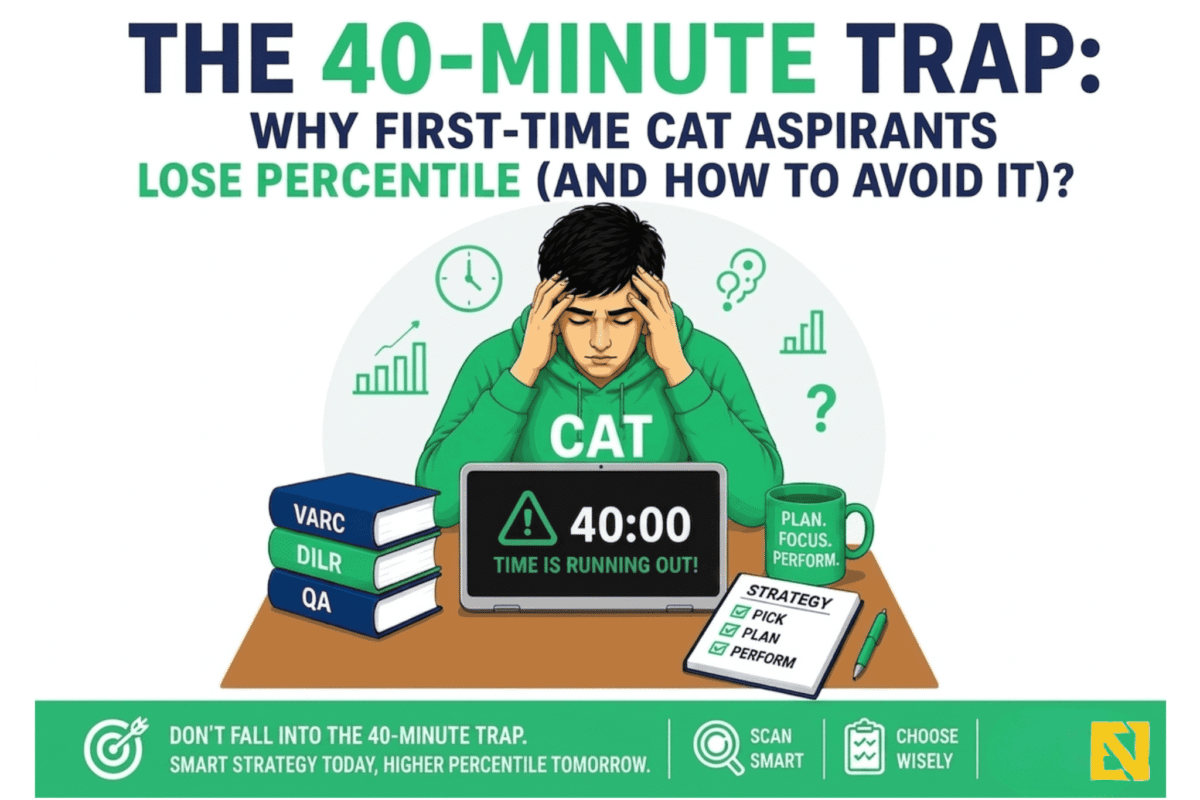
Many first-time aspirants fall into what can be called the “40-minute trap” – selecting wrong questions, spending too much time on them, and losing momentum, accuracy, and confidence.
Let’s break down the real challenges beginners face and how to overcome them effectively.
Key Factors and Common Mistakes First-Time CAT Aspirants Make

Anxiety Overload
Anxiety is natural when the stakes are high, but excessive worry reduces clarity and slows down thinking. It vanishes as soon as you start the exam and focus on what you have learned and how to apply it. Any negative thoughts about the result will only hamper your chances, so avoid them.
Aptitude vs Attitude
When focus shifts to small mistakes or outcomes, it becomes harder to stay composed and execute effectively. Aptitude helps you tackle 90% of the exam; the remaining 10% is determined by your attitude, which dictates how you perform under pressure. Overconfidence, anxiety, frustration, and panic can cost crucial marks.
Improper Selection of Question/Set
Many students start answering QA questions without categorising them (Easy, Moderate, and Intense) and attempt DILR sets in order, without scanning the section for easier ones. Consequently, they waste time on difficult or tricky questions and miss easier ones later in the paper.
Remember, smart selection matters more than brute effort. Selecting the right questions under time constraints is a skill that only develops through consistent practice in simulated environments.
Spending Too Much Time on One Question Set
Many students spend too much time on a single question or set and often fail to answer it correctly. Even after moving on, they remain mentally stuck on the previous question set.
Since all questions carry equal marks, attempting a tough question that does not award bonus marks can be a costly mistake. The goal should be to maximise your score, not to attempt every question.
Random Question Switching
Jumping between questions without a strategy creates confusion, wastes time, disrupts focus, and reduces efficiency; therefore, it should be avoided at all costs.
Over-Attempting Questions
Attempting too many questions in the hope of maximising one’s score often backfires. Random guesswork increases errors and reduces overall accuracy, lowering the final score because of negative marking for incorrect answers.
Reading Texts Time and Again while Attempting RC Questions
Many students return to the text multiple times to find, verify, or re-understand information while answering questions.
While sometimes necessary for accuracy, it often indicates low focus, poor retention, or a lack of active reading, which wastes valuable time. A better approach is to glance at the questions first to understand what to look for.
Carrying Sectional Baggage
A poor performance in one section negatively impacts the next. This mental carryover can significantly damage overall performance. When things go wrong, as they sometimes do, redefining goals and adjusting your approach can help you excel in the exam. Here, a rigorous practice of sectional tests is very helpful.
The QA section is usually the last, and by then, fatigue sets in. Students often fail to apply the logic effectively to questions due to low energy levels.
No Backup Plan
Many aspirants rely on a single strategy. When it fails, they struggle to adapt, leading to panic and poor decisions.
How Beginners Can Avoid These Mistakes
Long-Term Strategy (Before the CAT)
1. Build a Strong Foundation
Cover all topics thoroughly. CAT often mixes difficulty levels, featuring easy questions from advanced topics and tricky ones from basic topics.
- Practice questions across difficulty levels: easy, moderate, and advanced.
- Solve previous year questions (PYQs) topic-wise.
- Develop a smart strategy involving a mental map of problem-solving approaches.
- Improve reading habits with diverse content, and build a strong vocabulary by incorporating new words into your daily communication.
2. Practice with Purpose

Once you are thorough with the concepts, shift your focus to testing, analysing, and improving performance.
- Make a habit of taking practice tests at least 4-5 months before the exam.
- Try to attempt 90+ questions in mock tests (at least 30 from each section).
- Take 35-40 full-length and simulated mock tests, maintaining gaps in between.
Day 1: Attempt the mock tests and choose a different time slot for each section as per the CAT format.
Day 2: Analyse every test in depth to learn your mistakes, observe patterns, and make a mental map of questions and their solutions with an approach.
Day 3: Identify your weak areas and work on them with strategies.
- Solve PYQ papers with a timer.
The goal of taking mock tests is to improve the question selection strategy, reduce solving time, and keep your composure under pressure.
Exam-Day Strategy
1. Choose the Right Approach
A. Aggressive Strategy (For Well-Prepared Students)
Attempt 10-12 quant questions within the first 20 minutes of the exam.
Use the ABC approach to select and categorize questions on the basis of difficulty level, and answer them in that order.
A: Easy questions – Attempt them without a second thought and try to solve each question in less than 2 minutes.
B: Moderate questions – Mark these questions for review and attempt them after you are done with the easy ones.
C: Intense questions – Attempt them in the last, if time allows.
B. Balanced Strategy (For Moderately Prepared Students)
- Have a quick scan of all the LRDI and VARC questions before solving them.
- Leave time-taking sets and return to them later, or attempt 2-3 easy questions from each set and skip the difficult ones.
- Focus on maximising your scores with efficiency.
- Quickly scan each section before attempting the questions.
- First, attempt easy questions from your strong areas.
- Try to clear sectional cutoffs.
- Focus on accuracy rather than speed.
- Don’t get stuck on a question – move on to the next if you are unsure.
Words of Wisdom
- Consistency and discipline matter along with strategy.
- Give time to build all-important concepts for CAT.
- If you are stuck on a question or a set and cannot find a way out, move to the next question or set immediately, as staying on that one can lower the chances of a high score.
- Always re-read the last line of the question before marking the answer.
- Double-check your answer in TITA (Type In The Answer) questions.
- If there’s a technical issue, report it immediately, don’t panic.
- If the system fails in between, verify your saved answers once it is working again.
- Don’t do anything extraordinary, as it can backfire; just follow the process.
- Stay calm and trust yourself and your preparation.
Final Thoughts
The CAT is just to test your knowledge; it also tests your decision-making, time management, and mental resilience strategies. The “40-minute trap” is about making smarter choices even under pressure. Stay focused on the process, don’t worry about the result.
A calm mind helps to make clear strategies and motivates you to focus. All this leads to great results.
Let your mind lead the way while you enjoy taking the CAT!
Frequently Asked Questions
Q1. What is the meaning of the “40-minute trap” term in CAT?
The term means that you are wasting too much time on a difficult or wrong question at the initial stage of CAT. Doing so reduces your accuracy, confidence, and overall score.
Q2. How can I improve my question selection strategy for CAT?
First, quickly scan all the sections. Then, categorise the questions by difficulty level and start by attempting the easier ones.
Q3. Why is it important to analyse mock tests?
Analysing mock tests helps you learn your mistakes so that you can improve your strategy. Also, it helps manage time and make better decisions under exam pressure.